
Last verified:
Many business programs list well-known founders on their pages. For an applicant, the useful question is what each name meant in practice: a single talk, a taught course, a challenge set for students, or a relationship that continued over months.
Each of these has value, but they are not the same thing. This guide separates them using past examples from our PGP in Startup Leadership & Entrepreneurship at Mesa School of Business, all described on our program page, and sets out what to ask about the next intake.
Talks, visits and convocations
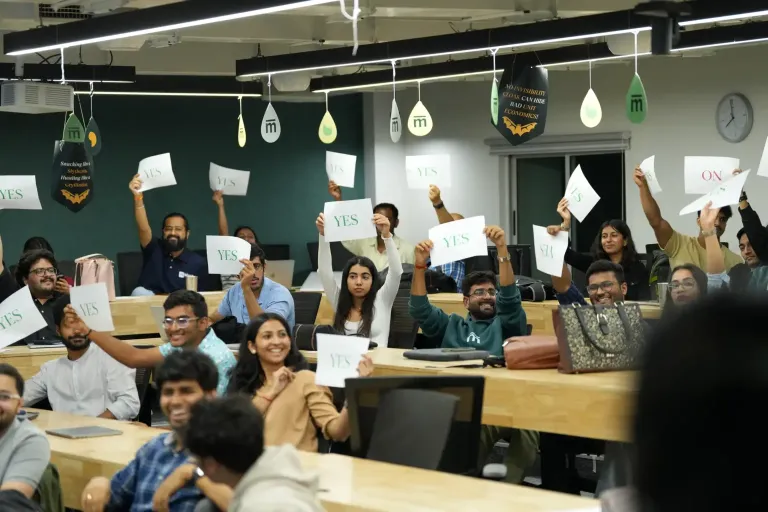
A talk gives students a founder’s account of real decisions and a chance to ask questions; its limit is that it usually happens once. Bert Mueller of California Burrito was hosted on campus for a session, and students had one-to-one time with him. Convocations are a different occasion again. Anupam Mittal of Shaadi.com was guest of honour at our Cohort 1 convocation, where students pitched at a demo day, and Ghazal Alagh of Mamaearth was guest of honour at our Cohort 2 convocation, where students also pitched live.
A list of supporters is a separate category. Our program page names founders who support Mesa School, including Kunal Shah (CRED), Vidit Aatrey (Meesho) and Vijay Shekhar Sharma (Paytm). Being named as a supporter describes support for the school.
Teaching and founder-set challenges
Teaching usually runs as a defined course or module over a set period. Professor Tim Calkins of Kellogg School of Management led Brand Week, which our program page describes as a five-day brand immersion with live challenges, ad reviews, hackathons and fireside chats.
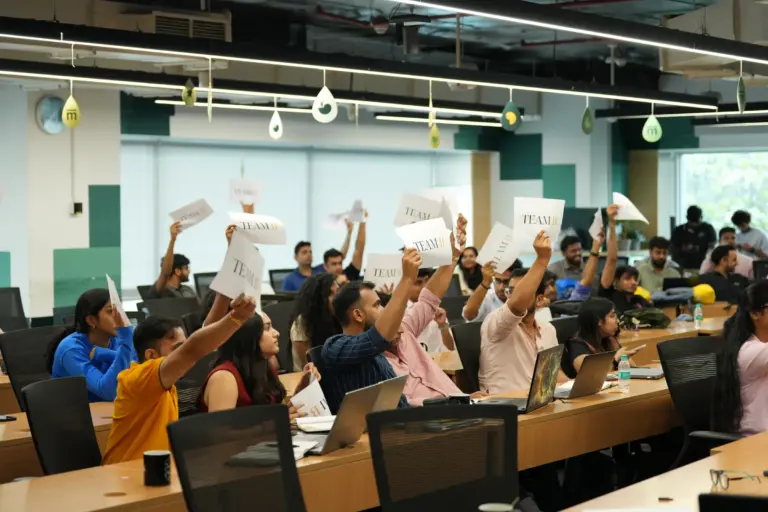
A founder-set challenge is narrower. Shantanu Deshpande, founder of Bombay Shaving Company, set our students a campaign challenge for the company’s newest razor, and teams ran consumer interviews, built decks, received mentor feedback and created spec ads in response. Our Business Strategy Lab usually works this way: founders or visiting faculty set the brief, shortlisted teams pitch their work to the founders, and the founders give the feedback. That puts students in front of founders on a real problem, not only in a talk. When a program cites a founder challenge, it is worth asking who set the brief, who judged the work and what feedback students received.
Ongoing mentorship: what is published and what to ask
Sustained mentorship is a continuing relationship in which the same person follows a student’s progress over time. It asks the most of everyone involved, so it deserves the most precise questions. Our PGP Outcomes Report 2025–26 lists more than 50 domain-specific mentors as part of career preparation. The report gives that count; it does not by itself say that each student keeps the same mentor throughout the year, or that every mentor is a founder.
For students building their own ventures, Mesa Startup Lab describes stage-matched mentors who change as a startup matures. Entry to the Lab is selective, and taking part does not guarantee funding or success. How mentors are allocated, how often students meet them and whether contact continues after the program are details worth confirming with our admissions team for the intake you are joining.
A checklist for any program, including ours
The table can be used to compare any program’s claims about founder access. The blank column is for the answers each program gives.
| Form of access | What it can offer | Question to ask | Answer |
|---|---|---|---|
| Talk or visit | A founder’s account of real decisions | How many sessions a year, and is there time for questions? | ____ |
| Classroom teaching | Depth over a set period, with assessed work | Who teaches which course, and for how many sessions? | ____ |
| Founder-set challenge | A real brief from a working company | Who judges the work, and what feedback do students get? | ____ |
| Ongoing mentorship | Advice that follows a student’s progress | How are mentors allocated, how often do students meet them, and for how long? | ____ |
Past examples show what has happened, not what the next intake will receive. Our page on what to know before you apply suggests asking for the details that matter to you in writing, and the last row of the table is the one most worth putting in writing.